A skate park is painting a simple logo on a rectangular sign. The logo is made from a single polygon with vertices joined in order: \(A(1,1)\), \(B(7,1)\), \(C(7,3)\), \(D(4,6)\), \(E(1,3)\), then back to \(A\).
The sign painter wants to use transformations to create a matching version of the same logo on the right-hand side of the sign.
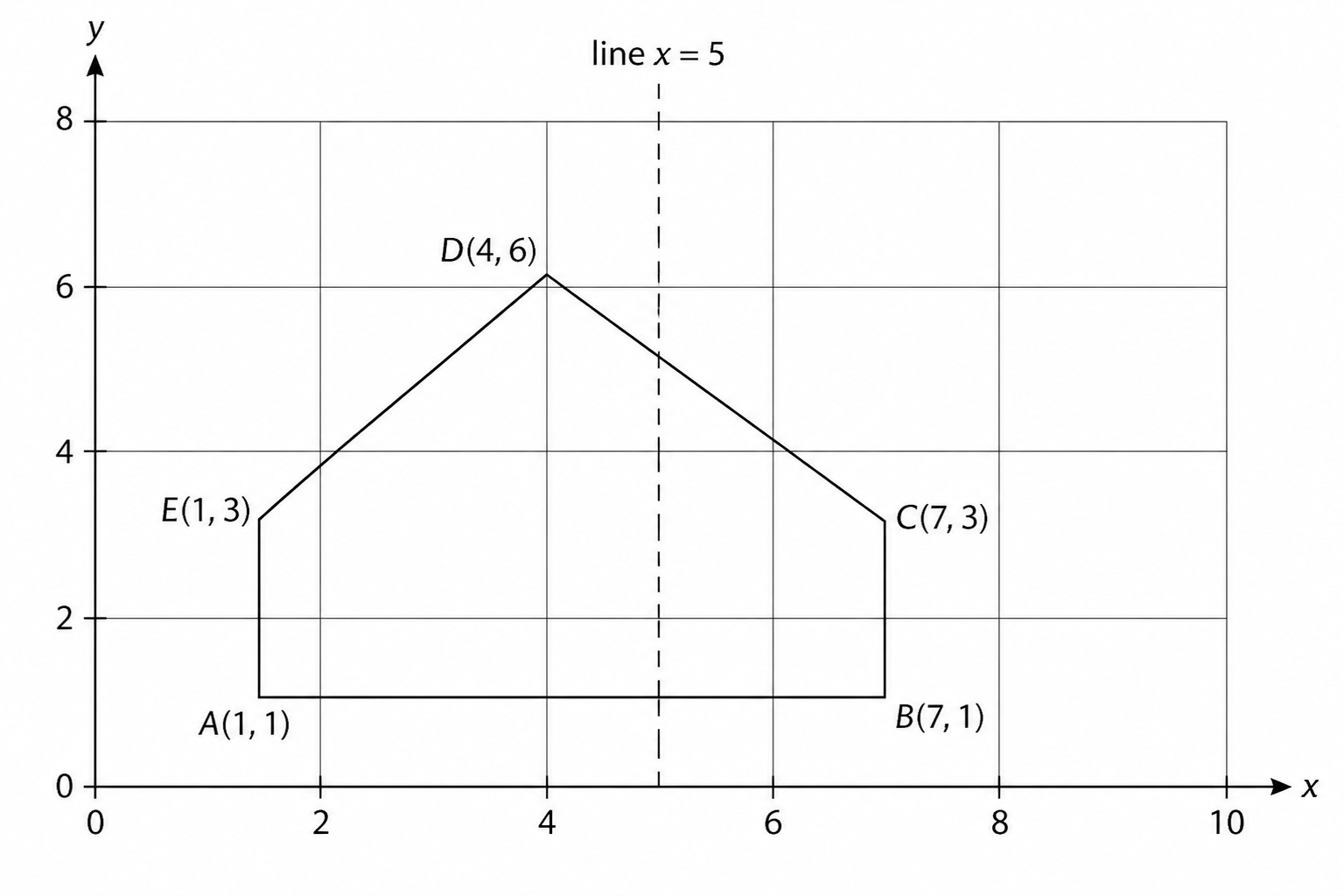
After the reflection, the painter wants the right-hand logo to be turned so that its “roof peak” points down instead of up, without changing its size. Propose a single rotation (centre and angle) that will do this to the reflected logo, and account for why your rotation works.
Marking your answer...
This may take a few seconds
Sign up for free to see your full marking breakdown and personalised study recommendations.
Create Free Account Log inThis is a free VCE Units 1 & 2 VM Numeracy practice question worth 4 marks, testing your understanding of Reflection, rotation and symmetry. It falls under Shape in Unit 1: VM Numeracy Unit 1. Submit your answer above to receive instant AI-powered marking and personalised feedback.
In Unit 1 students will develop their numeracy practices to make sense of their personal, public and vocational lives. They will develop mathematical skills with consideration of their local, community, national and global environments and contexts, and an awareness and use of appropriate technologies. These units provide students with the fundamental mathematical knowledge, skills, understandings and dispositions to solve problems in real contexts for a range of workplace, personal, further learning and community settings relevant to contemporary society.
In this area of study students will learn to recognise, describe and name common two- and three-dimensional shapes. They will classify, manipulate, represent and construct common and familiar shapes in diagrammatical and concrete forms. They will also become familiar with common characteristics and properties used in classifying shapes.
simple reflection, rotation and symmetry in relation to everyday familiar shapes
StudyPulse has thousands of VCE VM Numeracy questions with full AI feedback, mark breakdowns, progress tracking, and study notes across every Key Knowledge point including Reflection, rotation and symmetry.