A local council is deciding whether to convert a section of a busy shopping street from car parking to a protected bike lane. Two community groups post persuasive messages online.
Post A (text-only):
“A protected bike lane will make the street safer for everyone. When people feel safe to ride, more families choose bikes, which reduces congestion and improves air quality. Local businesses benefit because bike riders stop more often and spend locally. This is a practical change that supports health, safety and the local economy.”
Post B (text + visual):
“DON’T LET COUNCIL KILL OUR MAIN STREET.”
“Removing 18 car parks will destroy small businesses. If drivers can’t park, they’ll go elsewhere. Say NO to the bike lane.”
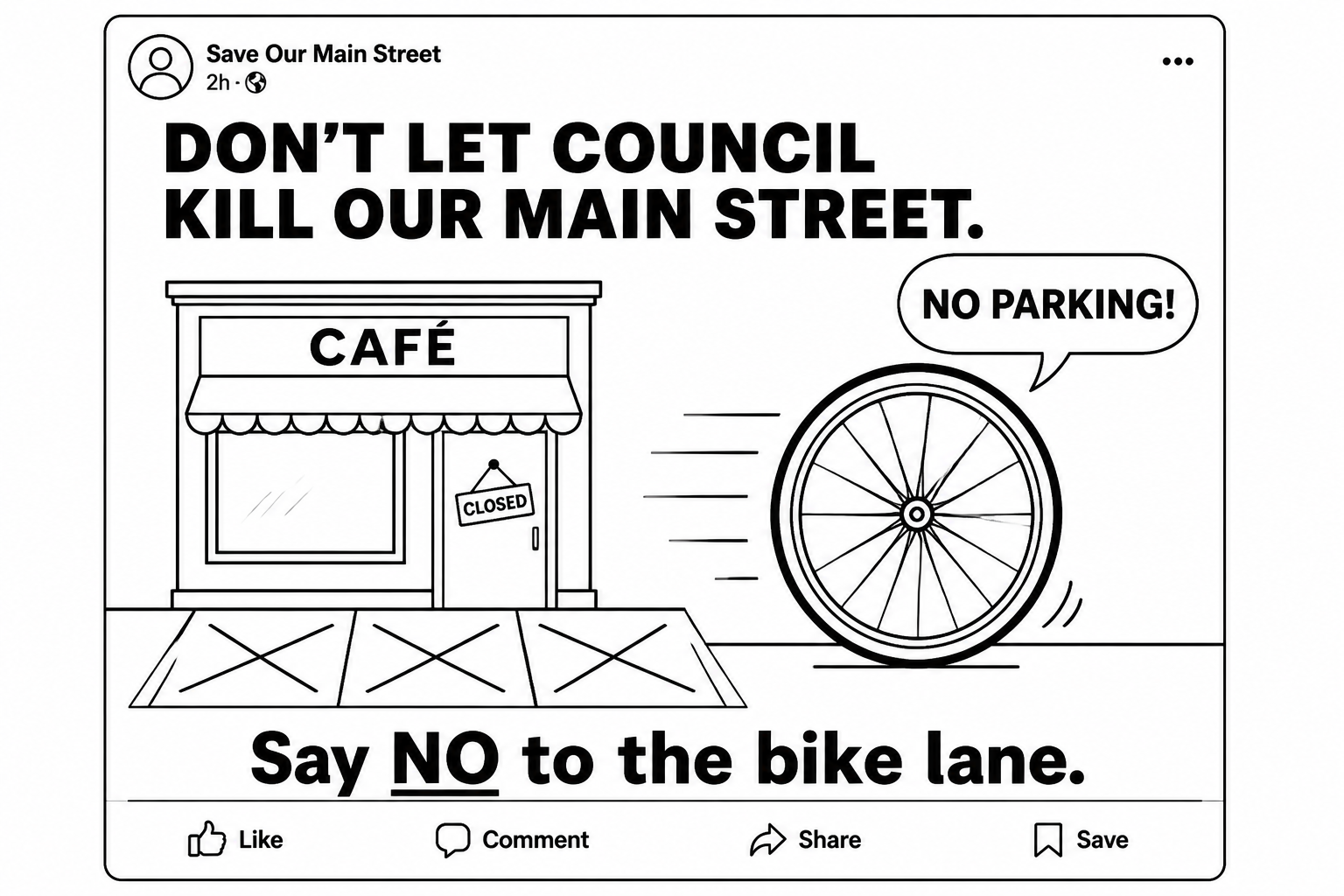
You are asked to evaluate how language and visuals contribute to the effectiveness of each group’s argument.
Extract two persuasive language features used in Post B and describe how each feature is intended to influence the audience.
Marking your answer...
This may take a few seconds
Sign up for free to see your full marking breakdown and personalised study recommendations.
Create Free Account Log inThis is a free VCE Units 1 & 2 VM Literacy practice question worth 4 marks, testing your understanding of Language and visuals in arguments. It falls under Responding to opinions in Unit 2: VM Literacy Unit 2. Submit your answer above to receive instant AI-powered marking and personalised feedback.
In Unit 2 of VM Literacy students work through the areas of study 'Understanding issues and voices' and 'Responding to opinions'.
In this area of study students practise their use of persuasive language and participate in discussion of issues, either in print, orally or via a digital platform. Students consider their own perspectives on issues and develop reasoned and logical responses to these discussions in a respectful and thoughtful manner. Students consider the arguments presented and critically analyse the language, evidence and logic of the arguments of others so that they can create their own response. In constructing their own responses, students select evidence that supports their viewpoint. Students learn to accurately reference and acknowledge the evidence they select.
language and visuals that contribute to the effectiveness of an argument
StudyPulse has thousands of VCE VM Literacy questions with full AI feedback, mark breakdowns, progress tracking, and study notes across every Key Knowledge point including Language and visuals in arguments.